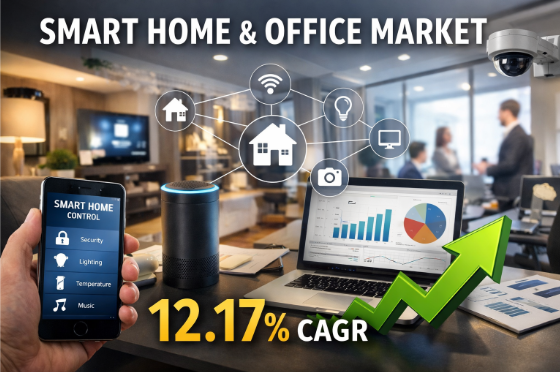
The Smart Home and Office Market is undergoing a structural transformation as digital technologies increasingly integrate with residential and commercial environments. Smart lighting, automated HVAC systems, connected security solutions, intelligent energy management, and voice-enabled assistants are no longer considered premium features; they are rapidly becoming standard expectations across homes and workplaces. This shift is being driven by rising urbanization, growing awareness of energy efficiency, and the widespread adoption of IoT-enabled devices. As organizations and households prioritize comfort, safety, and operational efficiency, the Smart Home and Office Market continues to gain strong global traction.
Smart Home and Office Market Size and Growth Outlook
As per the SNS Insider, The Smart Home and Office Market has demonstrated robust expansion in recent years, supported by strong technology adoption and favorable consumer behavior. In revised terms, the market was estimated at USD 39.24 billion in 2024 and is projected to advance to approximately USD 98.34 billion by 2032, registering a compound annual growth rate (CAGR) of 12.17% throughout the forecast period from 2025 to 2032. This sustained growth reflects rising investments in connected infrastructure, declining costs of smart devices, and increasing demand for integrated digital ecosystems in both residential and commercial settings.
Smart Home and Office Market Key Technology Trends
Technology innovation remains a cornerstone of the Smart Home and Office Market. Artificial intelligence and machine learning are enabling systems to learn user behavior and optimize performance automatically. Voice recognition platforms and smart assistants are becoming central control hubs, improving accessibility and user experience. Cloud-based platforms allow seamless device interoperability, while edge computing enhances response time and data security. Additionally, the growing deployment of 5G networks is strengthening real-time connectivity, enabling advanced applications such as predictive maintenance, remote facility management, and intelligent energy optimization across smart homes and offices.
Smart Home and Office Market Drivers and Opportunities
Several factors are accelerating growth in the Smart Home and Office Market. Rising energy costs are encouraging consumers and enterprises to adopt smart energy management systems that reduce consumption and improve sustainability. Increased remote and hybrid working models have boosted demand for smart office solutions that enhance productivity, security, and space utilization. Government initiatives supporting smart cities and green buildings are also creating favorable market conditions. Furthermore, opportunities are emerging from retrofitting existing buildings with smart technologies, particularly in developing economies where urban infrastructure modernization is gaining momentum.
Smart Home and Office Market Challenges and Constraints
Despite strong growth prospects, the Smart Home and Office Market faces certain challenges. Data privacy and cybersecurity concerns remain critical barriers, as connected devices are vulnerable to breaches if not adequately protected. High initial installation costs and compatibility issues between devices from different manufacturers can also limit adoption, especially among price-sensitive consumers. Additionally, lack of standardization across platforms can complicate system integration. Addressing these challenges through improved security frameworks, open standards, and cost-effective solutions will be essential for long-term market sustainability.
Smart Home and Office Market Application Analysis
Applications within the Smart Home and Office Market span residential, commercial, and institutional environments. In smart homes, lighting automation, security surveillance, smart thermostats, and entertainment systems dominate demand. In office environments, smart access control, occupancy sensors, intelligent lighting, and energy management systems are widely adopted to enhance operational efficiency and employee well-being. Healthcare facilities, educational institutions, and hospitality sectors are also increasingly deploying smart office solutions to improve safety, monitoring, and user experience, further broadening the application scope of the market.
Smart Home and Office Market Regional Growth Insights
Regional performance plays a vital role in shaping the Smart Home and Office Market landscape. North America continues to lead due to high consumer awareness, advanced infrastructure, and early adoption of connected technologies. Europe follows closely, driven by stringent energy efficiency regulations and strong emphasis on sustainable buildings. Meanwhile, the Asia-Pacific region is expected to witness the fastest growth during the forecast period, supported by rapid urbanization, expanding middle-class populations, and large-scale smart city initiatives in countries such as China, India, and South Korea. Emerging markets in Latin America and the Middle East are also showing increasing interest, creating new growth avenues.
Smart Home and Office Market Competitive Landscape
The competitive environment of the Smart Home and Office Market is characterized by continuous innovation and strategic collaborations. Market participants are focusing on product differentiation, platform integration, and ecosystem development to strengthen their market position. Partnerships between hardware manufacturers, software providers, and telecom companies are becoming increasingly common. Additionally, companies are investing in research and development to enhance device compatibility, cybersecurity features, and user-centric design, ensuring long-term competitiveness in a rapidly evolving market.
Smart Home and Office Market Future Outlook
The future of the Smart Home and Office Market appears highly promising as digital transformation accelerates across residential and commercial spaces. Advancements in AI, IoT, and connectivity will continue to redefine how people interact with their living and working environments. Growing emphasis on sustainability, energy efficiency, and smart infrastructure will further fuel adoption. As costs decline and interoperability improves, smart home and office solutions are expected to penetrate deeper into mainstream markets, reinforcing steady growth through 2032 and beyond.
FAQs
Q1. What is the CAGR of the Smart Home and Office Market during the forecast period?
The Smart Home and Office Market is expected to grow at a CAGR of 12.17% from 2025 to 2032, reflecting strong and sustained demand for connected residential and commercial solutions.
Q2. What is the forecast value of the Smart Home and Office Market by 2032?
By 2032, the Smart Home and Office Market is projected to reach approximately USD 98.34 billion, driven by rising adoption of smart technologies and supportive infrastructure development.
Q3. Which region is expected to witness the fastest growth in the Smart Home and Office Market?
The Asia-Pacific region is anticipated to experience the fastest growth due to rapid urbanization, expanding smart city projects, and increasing consumer adoption of smart home and office solutions.
Leave a Reply
You must be logged in to post a comment.