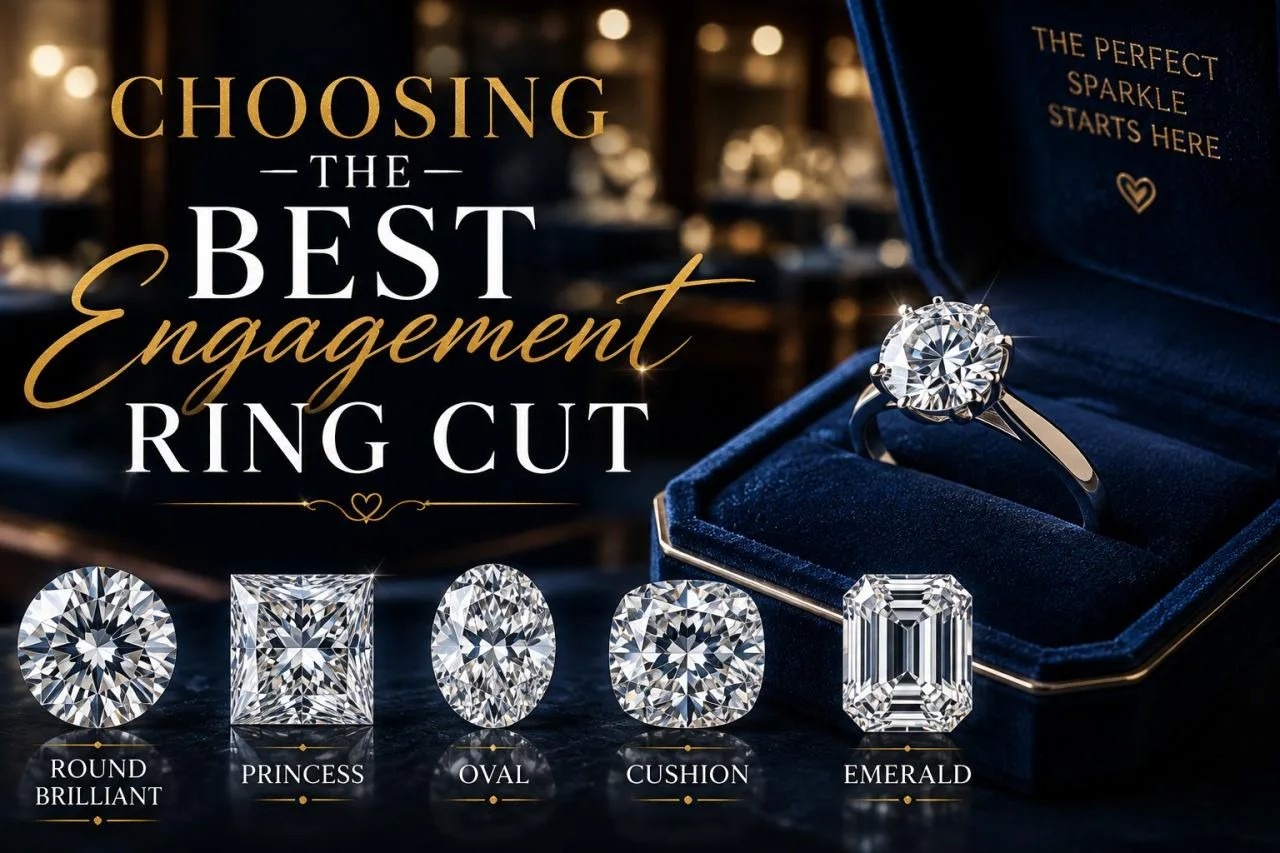
Choosing an engagement ring involves dozens of decisions, but few influence its overall appearance as much as the cut and shape of the center stone.
Round, oval, emerald, cushion, radiant, pear, marquise, princess, and Asscher stones can create completely different impressions, even when they have similar carat weights. Some emphasize intense sparkle, while others are prized for clean geometry, elongated proportions, vintage character, or understated elegance.
The challenge is that there is no single cut that works perfectly for everyone.
The right choice depends on personal style, lifestyle, budget, preferred setting, hand proportions, and what the wearer actually finds beautiful.
Understanding Cut Versus Shape
Before comparing engagement rings, it helps to understand an important distinction.
People frequently use “cut” and “shape” interchangeably, but they don’t mean exactly the same thing.
Shape describes the outline of the stone when viewed from above. Round, oval, pear, emerald, and marquise are examples.
Cut quality generally relates to how effectively the stone has been proportioned and faceted to interact with light.
Two round diamonds can therefore have the same shape but noticeably different visual performance.
Both characteristics deserve attention.
Start With Personal Style
Before comparing technical specifications, think about the person who will actually wear the ring.
What jewelry do they already own?
Do they prefer:
- Classic designs
- Minimalist jewelry
- Vintage-inspired pieces
- Bold statement jewelry
- Romantic styles
- Modern geometric designs
Existing jewelry can provide valuable clues.
Someone who consistently wears understated pieces may feel more comfortable with a simple solitaire than an elaborate halo.
Someone who loves Art Deco jewelry might immediately appreciate the geometry of an emerald or Asscher cut.
Round Brilliant: The Timeless Favorite
The round brilliant is one of the most recognizable engagement ring choices.
Its symmetrical shape works with almost every type of setting, including:
- Solitaires
- Pavé bands
- Halos
- Three-stone designs
- Vintage-inspired rings
- Contemporary settings
Round diamonds are particularly associated with brilliance and sparkle when properly cut.
For someone who wants a ring that feels traditional without appearing dated, round remains difficult to overlook.
Why Round Diamonds Sparkle So Much
The round brilliant cutting style is designed to interact strongly with light.
When the proportions, symmetry, and craftsmanship work together effectively, the result can be impressive brightness, fire, and scintillation.
This is an important reminder that carat weight alone doesn’t determine beauty.
A larger diamond with mediocre visual performance may be less compelling than a slightly smaller stone that interacts beautifully with light.
Round Isn’t Automatically the Right Choice
Popularity should never become the deciding factor.
Someone who loves elongated stones may find a round diamond too traditional.
Someone drawn to architectural jewelry may prefer an emerald cut.
The goal isn’t to choose what engagement rings are “supposed” to look like.
It is to find something the wearer genuinely wants to see on their hand every day.
Oval: Classic With an Elongated Twist
Oval diamonds combine a familiar brilliant appearance with an elongated silhouette.
That length can create an elegant appearance on the finger while offering substantial visual presence.
Oval diamonds work especially well with:
- Solitaires
- Hidden halos
- Pavé bands
- Three-stone settings
- Delicate bands
They can feel both contemporary and traditional, which helps explain their broad appeal.
Oval Diamonds Can Offer Excellent Finger Coverage
Carat measures weight rather than visible size.
Because oval diamonds distribute their weight differently from round stones, their elongated dimensions can create considerable face-up presence.
This can be appealing for someone who wants a center stone that looks substantial without necessarily prioritizing carat weight alone.
However, dimensions and proportions vary between individual stones.
Always evaluate the actual diamond rather than relying only on the number printed on a grading report.
Pay Attention to the Bow Tie
Some oval diamonds display a darker area across the center commonly called a bow tie.
The effect can range from barely noticeable to quite prominent.
There isn’t necessarily a specification that tells you exactly how distracting it will appear.
Look at the actual stone.
If your eye immediately goes to the dark center every time you see it, compare another oval.
Emerald Cut: Understated Sophistication
Emerald-cut diamonds provide a completely different visual experience.
Rather than emphasizing numerous small flashes of light, their step-cut faceting creates broader flashes and distinctive geometric patterns.
The result often feels:
Clean. Architectural. Elegant. Sophisticated.
For someone who prefers understated luxury over maximum sparkle, emerald cuts deserve serious consideration.
Emerald Cuts Reveal More of the Stone
Those large, open facets can also make internal characteristics easier to notice.
For this reason, clarity can become particularly important when evaluating emerald-cut diamonds.
However, don’t purchase according to a clarity grade alone.
Look at the actual diamond and determine whether any inclusions are noticeable under normal viewing conditions.
Emerald Cuts Shine in Simple Settings
An emerald-cut diamond already has a strong visual identity.
It doesn’t necessarily need an elaborate setting.
A simple solitaire can emphasize:
- Symmetry
- Length
- Step facets
- Clean lines
Pairing an emerald-cut center with a thin band can produce an especially refined appearance.
Cushion Cut: Soft and Romantic
Cushion-cut diamonds typically combine a square or rectangular outline with softened corners.
That creates a less angular appearance than some other geometric shapes.
Cushions can work particularly well for people drawn to:
- Romantic designs
- Vintage influences
- Halos
- Pavé
- Soft proportions
But “cushion cut” describes a broad category.
Two cushion diamonds can look surprisingly different.
Compare Different Cushion Shapes
Some cushions are nearly square.
Others are elongated.
Facet patterns can also vary.
When comparing cushions, consider:
- Length-to-width ratio
- Corner shape
- Faceting
- Overall outline
- Visual performance
Don’t assume that disliking one cushion means you dislike the entire category.
You may simply prefer a different proportion.
Radiant Cut: Geometry With Sparkle
Radiant-cut diamonds can be an excellent middle ground for someone who appreciates rectangular or square shapes but still wants plenty of brilliance.
Their faceting produces a different appearance from the broad step facets of an emerald cut.
Radiants can be:
- Square
- Slightly rectangular
- Noticeably elongated
That flexibility makes them useful for many ring styles.
Elongated Radiants Create a Bold Look
Elongated radiant cuts have become particularly appealing for people who want significant finger coverage and strong sparkle.
Their rectangular proportions can make the center stone feel visually substantial.
A simple setting can allow that shape to dominate the ring.
Add pavé or a hidden halo and the overall effect becomes more glamorous.
Pear Shape: Elegant and Distinctive
Pear-shaped diamonds combine a rounded end with a tapered point.
Their silhouette is immediately recognizable.
They can feel:
- Romantic
- Elegant
- Dramatic
- Individual
Pear diamonds can be especially appealing to someone who wants something different from round or oval without choosing an extremely unconventional design.
Pear Shapes Require Attention to Symmetry
The two sides of a pear should create an attractive, balanced outline.
Also pay attention to the transition between the rounded portion and the point.
Like ovals, pear-shaped diamonds may display a bow-tie effect.
Compare multiple stones instead of assuming all pears with similar specifications will look alike.
Which Direction Should a Pear Point?
Many people wear pear-shaped engagement rings with the point facing toward the fingertip.
Others prefer the opposite direction.
There is no universal requirement.
Wear it whichever way looks best to you.
That principle applies to far more engagement-ring decisions than people sometimes realize.
Marquise: Dramatic Finger Coverage
The marquise shape features an elongated body with pointed ends.
Its proportions can create substantial visible coverage and an elegant lengthening effect.
Depending on the setting, a marquise diamond can feel:
- Vintage
- Modern
- Romantic
- Dramatic
A minimalist solitaire can make a marquise look surprisingly contemporary.
Protect the Points
The distinctive points of a marquise deserve appropriate protection.
Prong placement and setting design can help protect vulnerable areas of the stone.
This is worth considering for anyone who plans to wear the engagement ring every day.
Beauty matters, but so does practicality.
Princess Cut: Sharp and Contemporary
Princess-cut diamonds generally have a square outline with brilliant-style faceting.
They appeal to people who want geometric symmetry without sacrificing significant sparkle.
A princess cut can look particularly good in:
- Modern solitaires
- Channel-set bands
- Pavé designs
- Three-stone rings
The clean square outline creates a very different personality from a round or oval diamond.
Princess-Cut Corners Need Protection
The pointed corners of princess-cut diamonds can be vulnerable.
A setting should appropriately protect those areas.
This is another reason the center stone and setting should be considered together.
Choosing a diamond first and treating the setting as an afterthought isn’t always the best approach.
Asscher Cut: Vintage Geometry
Asscher-cut diamonds have a square outline and distinctive step-cut faceting.
Their geometric appearance is particularly associated with vintage and Art Deco-inspired aesthetics.
An Asscher can be a strong choice for someone who appreciates:
- Symmetry
- Architecture
- Vintage jewelry
- Clean lines
- Unusual center stones
It doesn’t attempt to imitate the appearance of a brilliant-cut diamond.
That is part of its charm.
Step Cuts Produce a Different Type of Beauty
Emerald and Asscher cuts aren’t necessarily designed to produce the same type of visual performance as round brilliant diamonds.
Instead, their attraction comes from:
Broad flashes, depth, symmetry, and geometry.
Someone who prioritizes intense sparkle may prefer a brilliant-style stone.
Someone who loves elegant structure may prefer a step cut.
Neither preference is more correct.
Heart Shape: A Highly Personal Choice
Heart-shaped diamonds make the symbolism behind an engagement ring unmistakable.
They are much less conventional than round, oval, emerald, or cushion shapes.
That makes them particularly dependent on personal preference.
If the recipient loves heart-shaped jewelry, the design can feel incredibly meaningful.
If they generally prefer subtle jewelry, another option may fit their style better.
So, What Is the Best Engagement Ring Cut?
By this stage, the answer should be becoming clearer.
The best engagement ring cut is the one that creates the right combination of visual appeal, wearability, personality, and value for the individual wearing it.
That may be a classic round brilliant.
It might be an elongated oval.
It could be a dramatic marquise, sophisticated emerald, romantic cushion, or sparkling radiant.
Instead of looking for a universal winner, narrow the options according to the wearer’s preferences.
Shape Can Influence Perceived Size
Two diamonds with identical carat weights can look noticeably different once placed beside each other.
Why?
Because carat measures weight.
It doesn’t directly measure visible surface area.
Some elongated shapes can provide considerable face-up coverage, including:
- Oval
- Marquise
- Pear
- Elongated radiant
- Elongated cushion
This can be useful when balancing size preferences with budget.
Bigger Isn’t Automatically More Beautiful
Carat weight is one of the easiest diamond characteristics to understand.
A larger number sounds better.
But engagement rings aren’t spreadsheets.
The visual appearance of the stone depends on numerous characteristics beyond weight.
A slightly smaller stone with attractive proportions can look much more appealing than a heavier diamond with awkward dimensions.
Length-to-Width Ratio Changes Everything
Fancy-shaped diamonds can vary dramatically in proportion.
Consider an oval.
One might appear relatively wide and rounded.
Another might be long and narrow.
Both are technically ovals.
The same principle applies to:
- Emerald
- Radiant
- Cushion
- Pear
- Marquise
There isn’t necessarily one universally ideal ratio.
Personal preference matters enormously.
Look at Actual Measurements
When comparing stones, don’t stop at carat weight.
Review the dimensions.
The measurements help provide a better understanding of how the stone will actually appear when viewed from above.
This becomes especially useful when comparing diamonds of similar weight but different proportions.
Finger Shape Can Influence the Overall Look
You’ll find plenty of rules online claiming that certain diamond shapes belong on particular fingers.
Treat those rules as suggestions, not laws.
Elongated shapes can visually lengthen the finger.
Round and square stones create different proportions.
But the wearer’s reaction matters much more than an internet chart.
Try the ring on whenever possible.
Band Width Changes the Perception of the Center Stone
A center diamond can appear different depending on the band surrounding it.
A delicate band may make the stone appear more prominent.
A wider band creates a stronger visual presence of its own.
Neither approach is inherently better.
The proportions simply need to work together.
The Setting Can Completely Transform a Diamond
Take the same oval center stone and place it in three settings.
A yellow-gold solitaire may feel understated and classic.
A pavé band can feel glamorous.
A vintage halo can create a much more decorative appearance.
The diamond shape provides the foundation, but the setting determines much of the finished ring’s personality.
Solitaire Settings Let the Shape Speak
A solitaire places visual emphasis directly on the center stone.
This works particularly well when the diamond has a distinctive silhouette.
Oval, emerald, radiant, pear, marquise, and round stones can all look beautiful in simple solitaire settings.
For someone who prefers minimalism, additional decoration may be unnecessary.
Halos Add Visual Presence
A halo surrounds the center stone with smaller diamonds or gemstones.
This can increase:
- Sparkle
- Detail
- Visual coverage
- Overall glamour
However, a halo also changes how clearly you perceive the outline of the center stone.
Someone who loves the exact silhouette of an oval or emerald may prefer leaving that shape unobstructed.
Hidden Halos Offer a Subtle Alternative
A hidden halo places accent stones around the side or base of the center setting.
From directly above, the primary outline remains relatively clean.
From the side, additional sparkle becomes visible.
This can be an attractive option for someone who wants a relatively simple top view with a little more detail.
Three-Stone Rings Create Different Proportions
Three-stone engagement rings introduce side stones around the center.
Those side stones can complement the center shape or create contrast.
For example, an emerald-cut center can look beautiful beside tapered side diamonds.
The overall composition matters more than evaluating each stone independently.
Metal Color Matters Too
Diamond shape is only one part of the design.
Metal can dramatically influence the finished appearance.
Popular choices include:
- Yellow gold
- White gold
- Rose gold
- Platinum
Someone who already wears mostly yellow-gold jewelry may naturally prefer an engagement ring that coordinates with those pieces.
Look at what the recipient actually wears.
Consider the Wedding Band Before Finalizing the Ring
The engagement ring won’t necessarily be worn alone forever.
Some settings allow a straight wedding band to sit flush against the engagement ring.
Others may create a gap.
In those cases, options can include:
- Curved bands
- Contoured bands
- Custom bands
If having perfectly aligned rings matters, consider this during the engagement-ring design process.
Lifestyle Should Influence the Setting
An engagement ring may be worn thousands of hours every year.
Think about everyday life.
Does the wearer:
- Work frequently with their hands?
- Wear gloves professionally?
- Exercise often?
- Prefer low-maintenance jewelry?
- Remove jewelry during physical activities?
A highly elevated setting may be beautiful but inconvenient for someone constantly catching the ring on clothing or equipment.
High Settings Create Presence but Can Catch More Easily
A high-profile center stone can look dramatic.
It can also catch on:
- Sweaters
- Hair
- Gloves
- Fabrics
Some people barely notice this.
Others find it frustrating.
Try different setting heights to determine what feels comfortable.
Don’t Choose From Social Media Photos Alone
Engagement ring photography can distort expectations.
Close-up images make stones appear enormous.
Special lighting can maximize sparkle.
Camera angles can change proportions.
Evaluate rings from a normal viewing distance too.
The ring needs to look beautiful during everyday life, not only when photographed from two inches away.
Compare Diamonds Side by Side
Side-by-side comparison is one of the easiest ways to understand your preferences.
Take two similar diamonds.
Look at them under the same conditions.
Ask yourself:
Which one catches my attention first?
Then determine why.
Maybe one has better proportions.
Maybe you prefer its outline.
Maybe one simply looks brighter.
That visual reaction matters.
Don’t Obsess Over Specifications
Diamond grading information is valuable.
It helps buyers understand what they are comparing.
But the grading report isn’t the engagement ring.
The person wearing the ring will see the diamond, not the paperwork.
Use specifications to inform the decision rather than allowing them to make the entire decision.
Budget Can Help Narrow the Options
Establishing a realistic budget early makes shopping easier.
Once you know the range, you can decide where to prioritize.
Perhaps you care most about:
- Size
- Cut quality
- Color
- Clarity
- Setting
- Diamond origin
There are always tradeoffs.
Understanding your priorities helps you make them intentionally.
Natural and Lab-Grown Diamonds Create Different Options
Modern engagement-ring shoppers may consider both natural and laboratory-grown diamonds.
That choice can influence the combinations of size, color, clarity, and shape available within a particular budget.
Neither decision changes the fundamental process of selecting a shape.
You still need to choose something the wearer genuinely loves.
Alternative Gemstones Can Be Beautiful
Diamonds aren’t the only engagement-ring option.
Sapphires and other gemstones can create distinctive center stones.
However, engagement rings are typically worn frequently, so durability and maintenance deserve consideration.
Discuss how a particular gemstone will hold up to everyday wear before making the final choice.
Trends Should Provide Inspiration, Not Instructions
Engagement ring trends change continuously.
A particular year may favor:
- Ovals
- Elongated radiants
- Yellow gold
- Hidden halos
- Vintage settings
A few years later, preferences may shift.
Your ring doesn’t need to.
Choose something that feels personal enough to survive changing trends.
Look at the Jewelry They Already Love
This remains one of the most reliable clues.
Someone who owns mostly:
Simple jewelry may prefer a solitaire.
Someone who loves geometric jewelry might prefer emerald or Asscher.
Someone drawn to romantic jewelry may love cushion or pear shapes.
Someone who wears bold pieces may enjoy marquise or elongated radiant designs.
Personal style leaves clues everywhere.
Saved Photos Can Reveal Preferences
If you’re planning a surprise proposal, pay attention to patterns in saved inspiration.
One random photograph doesn’t mean much.
Twenty oval solitaire rings probably do.
Friends and family may also know whether the recipient has previously mentioned a specific preference.
Choose your confidants carefully if keeping the proposal secret matters.
Try Three Shapes Instead of Twenty
Too many choices can make engagement-ring shopping exhausting.
Create a shortlist.
For example:
Round
Oval
Emerald
Compare those directly.
If oval clearly wins, you can stop spending time looking at shapes that never excited you.
Then focus on finding the right oval.
Once You Choose the Shape, Compare Variations
Selecting “oval” isn’t the end.
Now compare:
- Longer ovals
- Wider ovals
- Different carat weights
- Different settings
- Different band widths
This second stage is where the ring begins becoming personal.
Don’t Rush Because of a Proposal Date
A planned proposal can create pressure.
But rushing an important purchase to meet an arbitrary deadline may not be worthwhile.
If necessary, adjust the plan.
The ring may be worn for decades.
Taking another week to compare options is insignificant in that context.
Ask the Jeweler Useful Questions
When comparing engagement ring cuts, consider asking:
- How does this stone perform in different lighting?
- Are there characteristics visible without magnification?
- How do its proportions compare with similar stones?
- Does it have a noticeable bow tie?
- Which settings protect this shape effectively?
- How high will the finished ring sit?
- What wedding bands work with this setting?
- What maintenance does the ring require?
- What documentation accompanies the stone?
- Can I compare several similar diamonds side by side?
Good questions help transform technical information into practical buying decisions.
Trust Your Eyes
At some point, diamond shopping can become overloaded with:
- Numbers
- Grades
- Measurements
- Ratios
- Charts
- Certificates
All of that information has value.
But eventually, look at the stones.
Which one do you want to keep looking at?
Which one makes the other options suddenly less interesting?
That reaction deserves consideration too.
FAQs
What is the most popular engagement ring cut?
Round brilliant diamonds have historically been among the most recognizable and widely selected choices. Oval, emerald, cushion, radiant, pear, and other shapes are also popular depending on individual preferences.
Which diamond shape looks the biggest?
Visible size depends on dimensions, proportions, setting, and finger size rather than shape alone. Elongated shapes such as oval, marquise, pear, and certain radiant cuts can provide substantial face-up coverage.
Which engagement ring shape sparkles the most?
Round brilliant diamonds are particularly associated with intense brilliance when properly cut. Other brilliant-style diamonds can also offer substantial sparkle, although their light patterns may look different.
Are emerald-cut diamonds less sparkly?
Emerald cuts create a different visual effect. Their step-cut faceting emphasizes broad flashes, depth, symmetry, and clean geometry rather than the smaller flashes associated with brilliant cuts.
Should engagement ring trends influence my decision?
They can provide inspiration, but they shouldn’t determine the final choice. Personal style, lifestyle, budget, and long-term preferences are more important.
Final Thoughts
Choosing an engagement ring cut becomes much easier once you stop searching for a universal winner.
There isn’t one.
A round brilliant can deliver timeless sparkle. An oval provides elegant length. An emerald cut offers architectural sophistication. A cushion creates a softer romantic appearance. A radiant combines geometry with brilliance. Pear and marquise shapes bring unmistakable personality.
The right choice depends on the person wearing the ring.
Look at their existing jewelry. Compare actual stones. Consider lifestyle. Think about the setting and wedding band. Pay attention to proportions instead of carat weight alone. And don’t allow trends to override personal preference.
Most importantly, notice which stone keeps drawing your attention.
Because after all the measurements, grading reports, comparisons, and technical specifications are considered, the engagement ring still needs to accomplish something remarkably simple:
The person wearing it should love looking at it.