| What this covers ● What Your Agreement Actually Says ● What Works When Nothing Can Be Attached to a Wall ● The Stability Test That Actually Predicts a Problem ● Height, and Why Renting Makes It Matter More ● The Moving-Day TestWhere to Put It When the Walls Are Out ● The Short Version |
Almost every guide to working in a small home assumes you own it. Wall-mounted fold-downs, floating shelves, desks built into alcoves, shelving anchored across a chimney breast. All of it requires putting holes in something that belongs to someone else.
If you rent, that advice is not slightly inconvenient. It is unusable. Here is what is left, and it is more than you might think.
What Your Agreement Actually Says
Start by reading it rather than assuming, because the range is wide.
A tenancy agreement typically restricts fixings to the structure. In practice that covers anything requiring a masonry or stud anchor, which includes every wall-mounted desk and most floating shelves. What it usually does not cover is picture hooks, adhesive fixings, freestanding furniture and anything that leaves no mark.
Two things people get wrong in opposite directions. Some assume a blanket ban and rule out fixings that are explicitly permitted. Others assume small holes will not be noticed, which is true right up until the check-out inspection, where a row of six anchor holes in plasterboard is both obvious and chargeable.
The practical position is that you should plan a workspace that needs no fixings at all, and treat anything permitted as a bonus rather than a foundation.
What Works When Nothing Can Be Attached to a Wall
| Option | Footprint when stored | Needs fixings | Main limitation |
| Folding desk | Flat against a wall | No | Mechanism wears before the surface |
| Console desk | Full, but shallow | No | Too shallow for a monitor |
| Rolling cart desk | Full, but movable | No | Must lock before use |
| Nested tables | One table’s footprint | No | Small work surface |
| Floor-level desk | Flat, stored | No | Requires floor seating or full height travel |
| Trestle desk | Disassembled flat | No | Assembly time is real |
| Wall-mounted | None | Yes | Not available to you |
Freestanding desks carry load through their own frame, which is a harder engineering problem than a wall-mounted desk faces. A wall-mounted surface borrows rigidity from the building. A freestanding one has to generate all of it from its own legs and joints, which is why a cheap freestanding desk wobbles and a cheap wall-mounted one usually does not.
That is the trade you are making, and it is worth spending money in the right place because of it. On a freestanding desk, the frame is what you are buying.
The Stability Test That Actually Predicts a Problem
Pressing down on a desk in a showroom tells you almost nothing. Desks fail in the horizontal plane, not the vertical one.
Put both hands flat on the surface and push sideways, as if sliding it. Then rest your forearms on it and type in the air with some force. Lateral movement and typing bounce are what you will notice every day. Vertical load is what almost never becomes a problem.
On a folding desk, do the same thing after opening and closing it ten times. Play in a mechanism shows up under cycling, not under load, and the desk you are testing in a shop has usually been opened twice.
Height, and Why Renting Makes It Matter More
In an owned home a workspace becomes permanent, so people eventually buy the right chair. In rented accommodation the chair is frequently a dining chair, borrowed from the table, at whatever height the table needed.
That combination puts a lot of people at the wrong height without any single decision having caused it. A dining chair sits higher than an office chair. A standard desk is fixed. There is no footrest because there is no room for one.
Height adjustment on the desk solves what you cannot solve with the chair, and in a rental it is often the only adjustable component you own. It also travels. A desk that adjusts fits the next flat as well as this one, whereas a desk sized around a particular chair in a particular room does not.
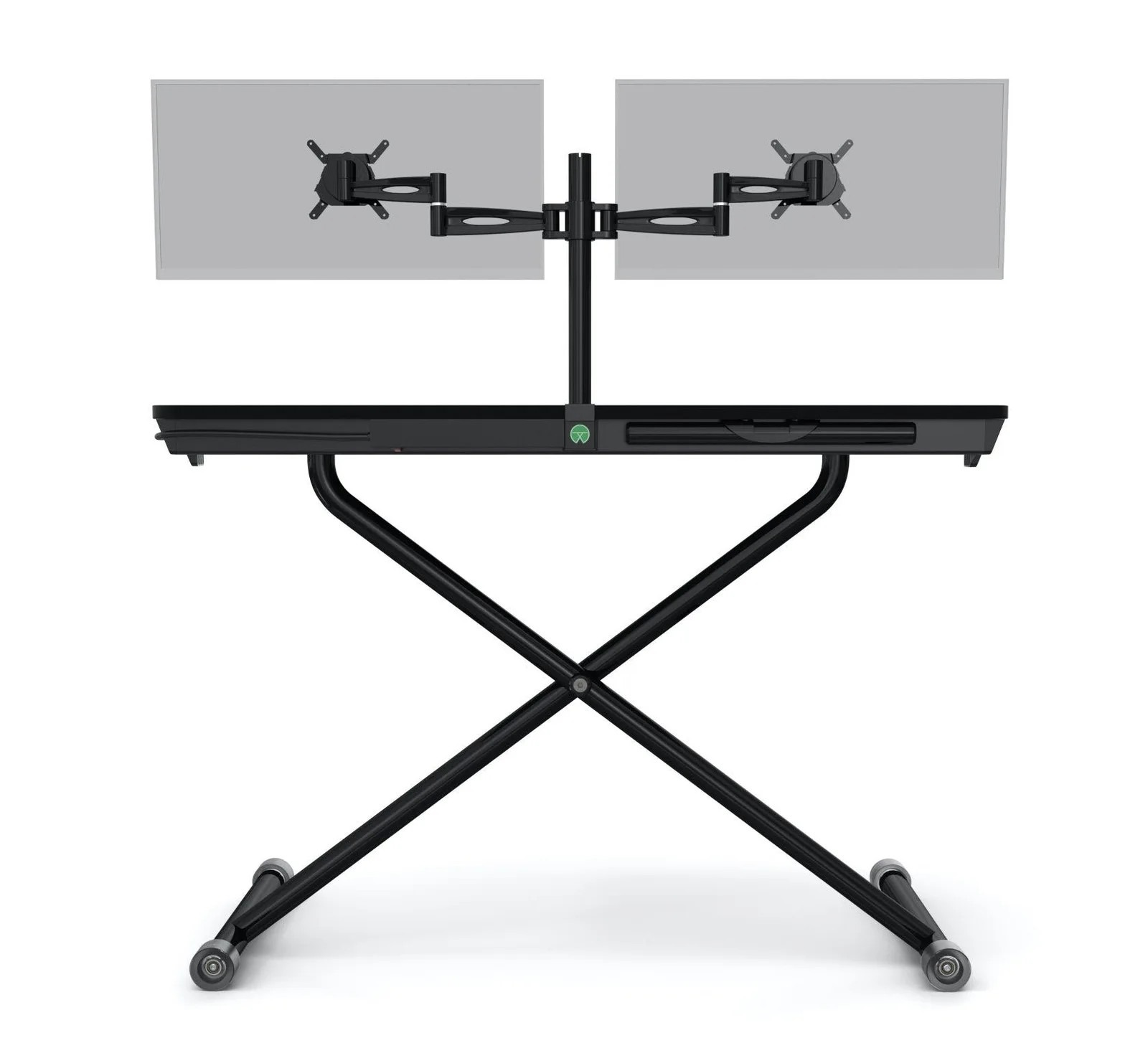
For a small rental where floor space is the binding constraint, a desk that travels from floor level upward is worth understanding before you default to a conventional compact desk, since it removes the chair from the equation entirely. A comparison of small space desk options covers where that sits against folding and wall-mounted approaches.
The Moving-Day Test
This is the criterion renters skip and owners never need.
Renters move more often than owners. Whatever you buy will be carried down a stairwell, put in a vehicle and reassembled, possibly more than once, inside the time you would still be paying it off.
Furniture that disassembles survives a move better than furniture that does not. Ask three questions before buying:
Does it come apart without special tools, and does it go back together without the joints loosening? A desk that is rigid on first assembly and wobbly on the second has cost you the price of a new desk.
Does it fit through a standard interior door at its narrowest dimension? Thirty inches is the number to beat, and a 46 inch desktop that does not detach from its frame will not make the turn on a stairwell.
Is it heavy enough that moving it needs two people? That is not a fault, but it changes the cost of every move, and it is worth knowing before rather than on the day.
A folding desk stores flat against a wall, which also means it travels flat, which makes it the easiest category on this list to move. That is a genuine advantage nobody mentions when comparing it on price.
Where to Put It When the Walls Are Out
With fixings unavailable, placement becomes the whole design.
Look for the recess rather than the empty wall. Chimney breasts, the space beside a wardrobe, the gap under a stairwell. These are places nothing else wants and a freestanding desk sits in them without needing to be attached to anything.
Face into the room rather than into a corner where you can manage it. Working with your back to the door in a small room is uncomfortable in a way that is hard to name and easy to feel, and in a studio it makes the workspace feel like a punishment.
Check the sockets before you commit. A desk placed perfectly for light and space and eight feet from the nearest outlet produces a trailing cable across a walking route, which in a small flat is both the safety problem and the reason the room never feels tidy.
The Short Version
Renting removes wall-mounted options, which is most of the published advice, and leaves you with freestanding furniture that has to earn its rigidity from its own frame.
Spend on the frame and the mechanism rather than the surface. Test for lateral movement rather than vertical load. Buy something that comes apart, because it will need to. And get the height adjustable, because the chair is not yours and the next flat will be a different shape.
None of that requires permission from anybody, which is the point.