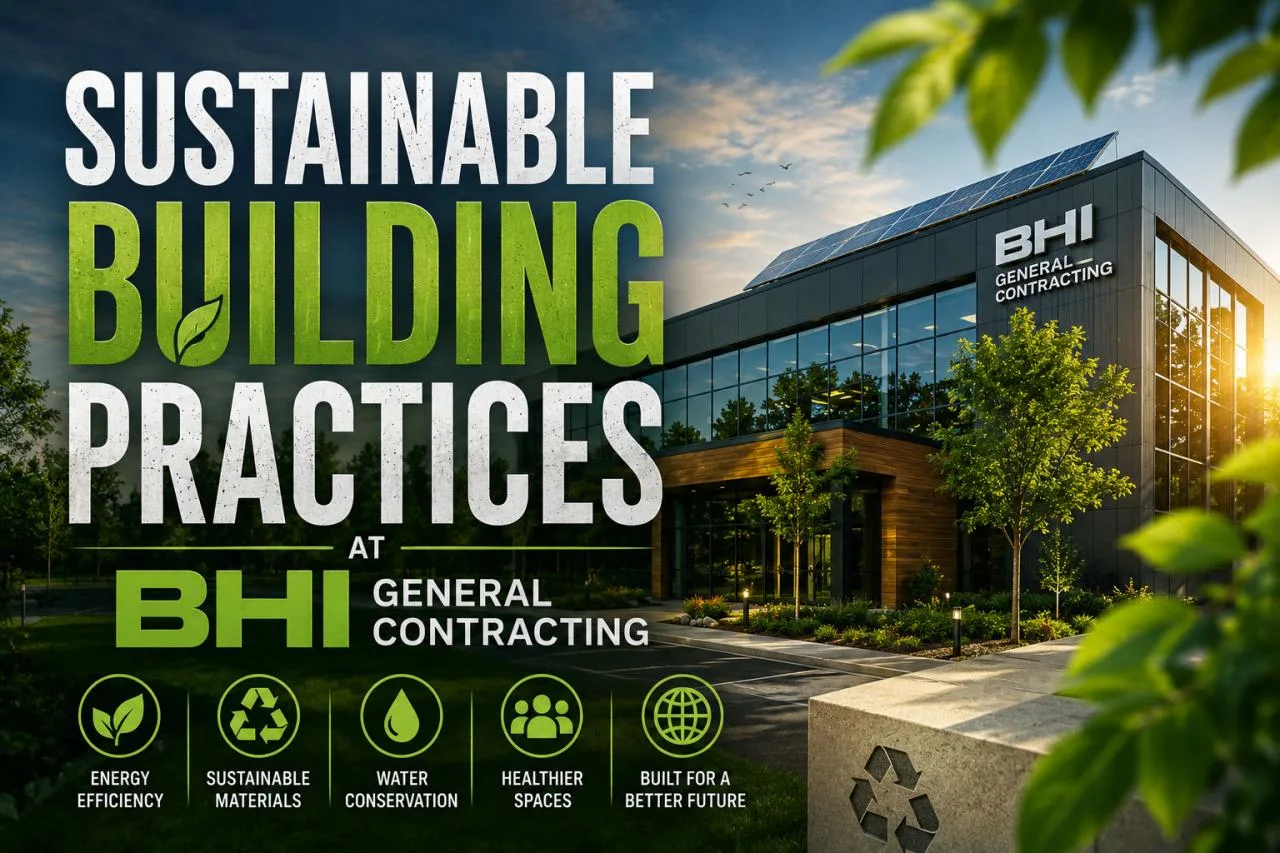
Sustainability in commercial construction is increasingly less about adding a handful of environmentally friendly features to a finished building and more about considering efficiency throughout the entire project.
Material selection, energy consumption, construction waste, water use, building orientation, mechanical systems, and long-term maintenance can all influence the environmental footprint of a commercial property. At the same time, owners and developers must balance these considerations against budgets, schedules, building codes, operational requirements, and the expected lifespan of the facility.
This makes sustainable construction a practical planning issue rather than simply an architectural trend.
For contractors, architects, engineers, developers, and property owners, the central question is no longer whether sustainability can be incorporated into commercial construction. It is determining which practices make sense for the particular building and how those decisions affect performance over decades of use.
Sustainability Starts Before Construction
Many important sustainability decisions happen before equipment arrives on the jobsite.
The planning stage can influence:
- Building orientation
- Material quantities
- Energy requirements
- Mechanical system design
- Natural lighting
- Water consumption
- Construction waste
- Future maintenance
Once construction begins, changing these fundamental decisions can become considerably more expensive.
Early coordination therefore gives project teams more opportunities to evaluate alternatives without disrupting the schedule.
Building for the Long Term
A sustainable building is not necessarily the one containing the largest number of environmental features.
Durability matters too.
A material that requires frequent replacement may create additional environmental and financial costs over the building’s lifespan.
Long-term planning considers questions such as:
- How long will this material last?
- How frequently will it require maintenance?
- Can components be repaired rather than replaced?
- Will replacement parts remain available?
- How will the building’s needs change over time?
This lifecycle perspective can produce different decisions than simply choosing materials according to their initial price.
Energy Efficiency Remains a Major Consideration
Commercial buildings can consume substantial energy through heating, cooling, lighting, equipment, and daily operations.
Reducing unnecessary consumption begins with the building itself.
The envelope, insulation, windows, doors, roofing, and air sealing can all influence how effectively interior conditions are maintained.
If the building envelope performs poorly, mechanical equipment may need to work harder to maintain comfortable temperatures.
Improving efficiency therefore requires looking at the building as a connected system.
The Building Envelope Matters
Walls, roofs, doors, windows, and insulation create the boundary between conditioned interior space and outdoor conditions.
Weaknesses in this envelope can contribute to:
- Heat loss
- Heat gain
- Air leakage
- Moisture problems
- Increased HVAC demand
Construction quality matters alongside material selection.
High-performance materials provide limited benefit if they are installed incorrectly or if gaps undermine the intended performance.
Insulation Should Match the Building
More insulation is not automatically the answer to every energy problem.
The appropriate approach depends on factors such as:
- Building type
- Climate
- Wall assembly
- Roof system
- Moisture management
- Local codes
- Operational requirements
A warehouse, restaurant, office, manufacturing plant, and healthcare facility may have very different needs.
Sustainable design works best when recommendations respond to the actual building rather than following a universal checklist.
High-Performance Windows Can Reduce Energy Demand
Windows affect both energy performance and occupant experience.
They can provide natural light and visual connections to the outdoors, but they can also contribute to unwanted heat transfer.
Window decisions may consider:
- Glazing
- Frame performance
- Orientation
- Solar exposure
- Shading
- Window-to-wall ratio
The objective is finding an appropriate balance between daylight, comfort, aesthetics, and energy performance.
Natural Light Can Reduce Dependence on Artificial Lighting
Daylighting can reduce the amount of electric lighting required during daytime hours.
It may also create more pleasant interior environments.
However, simply installing more windows is not necessarily sustainable.
Poorly planned glazing can introduce glare and excessive solar heat.
Effective daylighting considers where light enters, how deeply it reaches the building, and how occupants will use the space.
LED Lighting Has Changed Commercial Buildings
Lighting technology has improved significantly.
LED systems generally provide lower energy consumption and longer service life than many older lighting technologies.
Modern commercial lighting can also incorporate:
- Occupancy sensors
- Daylight sensors
- Scheduling
- Dimming
- Automated controls
These features can reduce unnecessary operation in spaces that do not require constant illumination.
Controls Can Be as Important as Equipment
Efficient equipment still wastes energy when it operates unnecessarily.
Controls allow building systems to respond to actual occupancy and demand.
For example, an empty conference room does not necessarily require the same lighting and environmental conditions as a fully occupied workspace.
Well-designed controls can help reduce unnecessary energy use without requiring occupants to constantly manage individual systems.
HVAC Efficiency Requires More Than New Equipment
Replacing old HVAC equipment with newer high-efficiency systems can reduce energy consumption, but equipment selection is only one part of the equation.
Performance also depends on:
- Proper sizing
- Ductwork
- Controls
- Building envelope
- Maintenance
- Occupancy patterns
Oversized or poorly configured systems may operate inefficiently despite impressive equipment specifications.
Mechanical design should therefore consider how the entire building operates.
Water Efficiency Is Another Part of Sustainable Construction
Energy receives substantial attention, but commercial buildings also consume water.
Depending on the property, water efficiency measures may include:
- Low-flow fixtures
- Efficient toilets
- Sensor-controlled faucets
- Irrigation controls
- Leak detection
- Water-efficient landscaping
The value of individual measures depends on how the building is used.
A restaurant has different water requirements from an office building.
Construction Waste Deserves Attention
Commercial construction naturally generates waste.
Packaging, offcuts, demolition materials, pallets, drywall, metal, concrete, and other materials can accumulate rapidly.
Better planning can help reduce unnecessary waste before it occurs.
For example, accurate material ordering can reduce excess inventory that eventually becomes disposal material.
Waste management can also identify materials suitable for recycling or reuse where practical.
Demolition Does Not Always Mean Disposal
Renovation and modernization projects can create opportunities to preserve existing materials.
Depending on their condition, components may potentially be:
- Reused
- Recycled
- Repurposed
- Salvaged
This does not mean everything should be retained.
Old materials may be damaged, inefficient, contaminated, or incompatible with current codes.
The useful question is whether removal is necessary and what should happen to the material afterward.
Adaptive Reuse Can Extend a Building’s Life
Sometimes the most sustainable building is one that already exists.
Adaptive reuse involves converting an existing structure for a new purpose rather than demolishing it and beginning again.
Examples might include transforming:
- Warehouses into offices
- Industrial buildings into mixed-use properties
- Older retail buildings into new commercial spaces
These projects can preserve substantial portions of the existing structure.
However, they also introduce challenges involving code compliance, mechanical systems, accessibility, and structural conditions.
Existing Buildings Can Hide Complications
Reusing a structure is not automatically simpler than new construction.
Older properties may contain:
- Outdated electrical systems
- Aging plumbing
- Structural deficiencies
- Inefficient insulation
- Hazardous materials
- Accessibility issues
A thorough assessment is important before deciding which components should remain.
Sustainability should not come at the expense of safety or building performance.
Material Selection Has Multiple Dimensions
Calling a material “sustainable” can oversimplify the issue.
Several questions may matter:
- Where was it manufactured?
- How long will it last?
- Can it be recycled?
- Does it contain recycled content?
- How much maintenance does it require?
- What happens at the end of its useful life?
A material that performs exceptionally for several decades may sometimes be preferable to one that appears environmentally attractive initially but requires frequent replacement.
Local Materials Can Reduce Transportation
When suitable materials are available closer to the project, transportation requirements may be reduced.
Local sourcing can also support regional suppliers.
However, distance should not be the only consideration.
Availability, performance, cost, durability, and project requirements remain important.
The closest material is not necessarily the most appropriate one.
Recycled Content Can Reduce Demand for Virgin Materials
Some commercial construction products incorporate recycled materials.
Examples may include certain:
- Steel products
- Flooring
- Insulation
- Concrete components
- Ceiling systems
Recycled content can contribute to sustainability objectives when the material also meets the project’s technical and performance requirements.
Again, environmental attributes should be evaluated alongside durability and suitability.
Concrete Presents Both Challenges and Opportunities
Concrete is essential to many commercial and industrial projects.
Its production also carries significant environmental considerations.
Project teams may examine options involving:
- Mix design
- Material efficiency
- Supplementary cementitious materials
- Structural optimization
Any changes must still meet engineering requirements.
Structural performance cannot be compromised simply to achieve an environmental objective.
Steel Offers Durability and Recyclability
Steel is widely used in commercial and industrial construction because of its structural capabilities.
It also has a well-established recycling pathway.
Steel components can contain recycled material and may themselves be recyclable at the end of a building’s service life.
Its suitability depends on structural design, cost, availability, and project requirements.
Durability Is a Sustainability Strategy
A commercial roof that lasts longer before replacement can reduce material consumption over the building’s life.
The same principle applies to:
- Flooring
- Exterior cladding
- Doors
- Windows
- Structural systems
- Interior finishes
Durability rarely receives the same attention as visible green technologies, but it can be one of the most practical sustainability considerations.
Maintenance Should Influence Design Decisions
Buildings need maintenance.
Designers and contractors can make that maintenance easier or more difficult.
Accessible mechanical equipment, replaceable components, logical service routes, and durable finishes can simplify future work.
A building that is difficult to maintain may experience deferred repairs, which can eventually reduce performance.
Planning for maintenance is therefore part of planning for longevity.
Flexible Spaces Can Reduce Future Renovation
Commercial needs change.
Companies grow.
Departments move.
Technology changes.
Warehouses adopt new equipment.
Retailers alter layouts.
Designing adaptable spaces can reduce the amount of demolition and reconstruction required when those changes occur.
Flexibility might involve:
- Modular partitions
- Accessible utilities
- Flexible electrical systems
- Adaptable floor plans
The appropriate strategy depends heavily on the building’s intended use.
Sustainable Construction Must Still Support Operations
A manufacturing facility cannot sacrifice production requirements for environmental features.
A healthcare building cannot compromise infection-control requirements.
A warehouse still needs appropriate clear heights and loading configurations.
An office still needs comfortable working conditions.
Sustainable construction works best when environmental goals support the building’s actual function.
Industrial Buildings Require a Different Perspective
Industrial facilities often have energy demands that extend well beyond ordinary building systems.
Manufacturing equipment, ventilation, compressed air, process heating, refrigeration, and other systems can account for substantial consumption.
Sustainable industrial construction therefore requires coordination between the building and the processes operating inside it.
Optimizing office lighting while ignoring major production equipment would provide an incomplete picture.
Warehouses Present Their Own Opportunities
Warehouse sustainability may involve:
- Efficient lighting
- High-performance roofing
- Insulation
- HVAC zoning
- Dock-door management
- Efficient material flow
Large roof areas may also create opportunities for certain energy technologies where technically and economically appropriate.
But the strategy should begin with how the facility actually operates.
Roofing Can Influence Building Performance
Commercial roofs experience significant exposure to sunlight and weather.
Roofing decisions may consider:
- Insulation
- Reflectivity
- Durability
- Drainage
- Maintenance
- Potential future equipment
A roof expected to support solar equipment, for example, may require different planning than one without that expectation.
Considering these issues early can prevent expensive modifications later.
Renewable Energy Should Follow Efficiency
Solar panels are one of the most visible symbols of sustainable construction.
But renewable generation should not distract from basic efficiency.
Before generating additional energy, it can make sense to determine whether the building is unnecessarily wasting energy through:
- Poor insulation
- Inefficient lighting
- Outdated equipment
- Air leakage
- Poor controls
Reducing demand can change the scale of renewable systems required.
Solar Requires Site-Specific Evaluation
Not every commercial building is automatically suitable for solar.
Factors include:
- Roof orientation
- Structural capacity
- Shading
- Available area
- Electrical infrastructure
- Energy consumption
- Financial considerations
A detailed evaluation is more useful than assuming solar is appropriate simply because the roof is large.
Building Orientation Can Influence Performance
For new construction, orientation may influence:
- Solar exposure
- Daylighting
- Heat gain
- Window placement
- Outdoor spaces
Site constraints often limit flexibility.
Road access, utilities, zoning, neighboring properties, topography, and operational requirements may dictate much of the building position.
Still, orientation is worth evaluating during early design.
Site Planning Is Part of Sustainability
The environmental footprint of a commercial project extends beyond the building walls.
Site decisions can involve:
- Stormwater
- Landscaping
- Parking
- Transportation
- Existing vegetation
- Soil disturbance
A thoughtful site plan considers how these systems interact.
For example, landscaping choices can affect both irrigation requirements and stormwater behavior.
Stormwater Management Is Increasingly Important
Large commercial properties can contain substantial impervious surfaces.
Roofs, parking lots, and driveways change how rainfall moves across a site.
Stormwater planning may incorporate different strategies depending on local requirements and site conditions.
The objective is to manage water responsibly while protecting the property and surrounding infrastructure.
Landscaping Can Reduce Water Demand
Traditional landscaping can require significant irrigation.
Using plants suited to local climate conditions may reduce water requirements once established.
Landscape design can also consider:
- Shade
- Erosion
- Stormwater
- Maintenance
- Biodiversity
As with building materials, the right solution depends on the site.
Construction Equipment Also Has an Environmental Footprint
Sustainability discussions often focus on the finished building.
The construction process itself also consumes:
- Fuel
- Electricity
- Water
- Materials
Efficient scheduling and logistics can reduce unnecessary equipment operation and repeated transportation.
These improvements may also support productivity, demonstrating how environmental and operational objectives can sometimes align.
Better Planning Can Reduce Material Waste
Design changes during construction can create waste.
So can inaccurate orders and poor coordination.
Building information modeling, detailed estimating, prefabrication, and improved communication may help teams order and fabricate materials more precisely.
Waste reduction is therefore closely connected with project management.
Prefabrication Can Offer Efficiency Advantages
Some building components can be manufactured off-site and assembled on-site.
Depending on the project, prefabrication may provide:
- More controlled production
- Reduced material waste
- Faster installation
- Improved consistency
It is not appropriate for every project.
But when design and logistics support it, prefabrication can contribute to both efficiency and construction quality.
Sustainable Practices Need Coordination Across the Team
Architects cannot achieve sustainable performance alone.
Neither can contractors.
Successful implementation may require collaboration among:
- Owners
- Architects
- Engineers
- General contractors
- Subcontractors
- Suppliers
- Facility managers
A decision affecting one system can influence another.
Changing glazing, for example, may influence HVAC loads.
Changing structural systems may affect material quantities and schedules.
Coordination helps identify those relationships early.
Contractors Have a Practical Role in Sustainability
Design teams may establish sustainability objectives, but contractors ultimately translate many of those ideas into built conditions.
Constructability matters.
Availability matters.
Sequencing matters.
Installation quality matters.
A contractor can identify when a theoretically attractive solution creates practical problems or when an alternative may achieve a similar objective more efficiently.
That practical perspective becomes especially important on complex commercial and industrial projects.
Sustainability at BHI General Contracting Fits Into a Larger Industry Shift
The discussion around BHI General Contracting and sustainable construction reflects a broader change occurring throughout commercial building. Sustainability is increasingly considered alongside constructability, lifecycle cost, operational efficiency, material performance, and long-term facility needs rather than being treated as a separate category added at the end of design.
For owners, this broader perspective can be useful because it focuses attention on how buildings actually perform after construction is complete.
Lifecycle Cost Can Be More Useful Than Initial Cost
A cheaper material is not necessarily less expensive over 20 years.
Suppose Material A costs less initially but needs replacement twice.
Material B costs more but lasts significantly longer.
The correct financial comparison needs to consider:
- Initial purchase
- Installation
- Maintenance
- Energy consumption
- Replacement
- Disposal
Lifecycle analysis can reveal costs that are invisible in the initial construction budget.
Sustainable Features Need a Business Case
Commercial property owners have financial responsibilities.
Sustainability decisions therefore often need to make economic sense.
Potential benefits may include:
- Reduced utility consumption
- Lower maintenance
- Longer material life
- Improved building performance
- Reduced waste
Not every sustainable feature produces a rapid financial return.
Owners need to understand both costs and expected benefits.
Payback Period Is Only One Metric
A sustainability improvement is sometimes evaluated entirely by how quickly it pays for itself.
That can be useful, but it is not the only consideration.
Other factors may include:
- Equipment lifespan
- Energy-price uncertainty
- Maintenance reduction
- Tenant expectations
- Regulatory changes
- Property value
Commercial buildings are long-term assets.
Short-term payback calculations may not capture every relevant benefit.
Certification Can Provide a Framework
Some projects pursue formal green-building certifications.
These programs can provide structured criteria involving:
- Energy
- Water
- Materials
- Indoor environment
- Site development
Certification can be valuable when it aligns with owner objectives.
However, a building does not need a plaque to incorporate thoughtful sustainability practices.
The appropriate approach depends on the project.
Codes Are Also Becoming More Performance-Oriented
Building and energy codes continue to evolve.
Practices once considered unusually efficient can eventually become standard requirements.
This creates another reason to think beyond minimum current compliance.
A building constructed today may still be operating decades from now.
Owners may benefit from considering how expectations could change during that lifespan.
Indoor Environmental Quality Matters
Sustainability is not exclusively about reducing energy consumption.
Commercial buildings exist for people.
Design decisions can influence:
- Lighting
- Air quality
- Temperature
- Acoustics
- Comfort
A highly efficient building that creates an uncomfortable environment for occupants has not necessarily achieved a successful outcome.
Performance should include human experience.
Material Emissions Can Be Considered
Some interior materials can release volatile organic compounds or other substances.
Projects concerned with indoor environmental quality may evaluate:
- Paints
- Adhesives
- Flooring
- Sealants
- Composite products
Material specifications can help reduce unnecessary indoor pollutants.
Again, product selection must also consider performance and durability.
Commissioning Can Help Buildings Operate as Intended
A building may contain efficient systems but still underperform if they are configured incorrectly.
Commissioning can help verify that systems are operating according to design intent.
This may involve:
- HVAC
- Controls
- Lighting
- Electrical systems
- Other building equipment
Identifying problems before occupancy can prevent years of unnecessary energy consumption.
Facility Managers Should Be Part of the Conversation
The people who operate a building after construction can provide valuable insight during planning.
Facility managers understand recurring problems involving:
- Maintenance
- Access
- Equipment
- Controls
- Replacement
- Daily operations
Including operational perspectives early can improve long-term performance.
Occupant Behavior Still Matters
Technology cannot eliminate human behavior.
Lights can be efficient, but they still consume electricity when left on unnecessarily.
HVAC equipment can be sophisticated, but unrealistic thermostat settings can increase demand.
Building controls can reduce some of these problems, but education and operational policies remain important.
Measure Performance After Occupancy
Sustainability should not end when construction does.
Actual performance can be compared with expectations.
Owners can monitor:
- Energy consumption
- Water use
- Maintenance
- Equipment performance
- Occupant comfort
If consumption is unexpectedly high, the data can help identify potential problems.
Existing Commercial Buildings Offer Major Opportunities
New construction receives significant attention because efficiency can be designed from the beginning.
But existing buildings represent an enormous opportunity.
Modernization projects can address:
- Lighting
- Controls
- HVAC
- Roofing
- Insulation
- Windows
- Water fixtures
Improvements can often be phased according to budgets and operational schedules.
Renovation Can Target the Biggest Problems First
An existing building does not necessarily need a complete sustainability overhaul.
Energy audits and facility assessments can identify where the largest inefficiencies occur.
Perhaps lighting is already efficient, but HVAC is outdated.
Maybe mechanical equipment is modern, but the building envelope performs poorly.
Prioritization helps direct investment toward areas with greater potential impact.
Sustainability and Resilience Can Overlap
Buildings also need to withstand changing conditions.
Resilience may involve considerations related to:
- Severe weather
- Power interruptions
- Water management
- Temperature extremes
- Material durability
Some strategies that improve sustainability can also improve resilience.
For example, better insulation can reduce energy demand while helping buildings maintain interior conditions during equipment interruptions.
There Is No Universal Sustainable Building
A sustainable warehouse in Cincinnati may look very different from a sustainable office in Phoenix.
Climate, building use, regulations, available materials, energy costs, and operational patterns all influence the appropriate strategy.
This is why checklists should be used carefully.
Sustainability requires context.
Questions Owners Should Ask During Planning
Before construction begins, owners can ask:
- Where will the building consume the most energy?
- Which materials will require frequent replacement?
- Can existing structures or materials be retained?
- How will construction waste be managed?
- Are water-saving measures appropriate?
- How easy will the building be to maintain?
- Can spaces adapt to future uses?
- What systems should be monitored after occupancy?
- Which improvements provide meaningful lifecycle value?
- How do sustainability goals affect the construction schedule and budget?
These questions encourage practical discussion rather than treating sustainability as a marketing label.
Avoid Sustainability for Appearance Alone
A highly visible environmental feature may look impressive without addressing the building’s largest sources of consumption.
Conversely, some of the most effective improvements may be almost invisible.
Better insulation is not particularly exciting to photograph.
Neither are properly sealed penetrations or well-configured HVAC controls.
Yet these details can influence building performance every day.
Sustainable Construction Is Often About Better Fundamentals
Many effective practices are not futuristic.
They involve:
- Designing carefully
- Ordering accurately
- Building durably
- Reducing waste
- Installing systems correctly
- Maintaining equipment
- Measuring performance
In other words, sustainability frequently overlaps with good construction practice.
FAQs
What makes a commercial building sustainable?
Sustainable commercial construction can involve energy efficiency, water conservation, responsible material selection, waste reduction, durability, adaptable design, and attention to long-term building operations.
Are sustainable commercial buildings more expensive to construct?
Some features can increase initial costs, while others may have limited cost impact or even reduce expenses. The more useful comparison often considers lifecycle costs, including energy, maintenance, and replacement.
Can existing commercial buildings become more sustainable?
Yes. Existing properties can often improve performance through upgrades to lighting, HVAC, controls, roofing, insulation, water fixtures, and other systems.
Does sustainable construction require green-building certification?
No. Certification programs can provide useful frameworks, but commercial buildings can incorporate sustainable practices without pursuing formal certification.
Why is durability considered part of sustainability?
Long-lasting materials may reduce the frequency of replacement, which can decrease future material consumption, labor, transportation, and waste.
When should sustainability be discussed during a construction project?
Ideally, during early planning and design. Early decisions involving orientation, systems, materials, and building configuration can be difficult or expensive to change once construction is underway.
Final Thoughts
Sustainable commercial construction is becoming less about isolated “green” features and more about how buildings are planned, constructed, operated, maintained, and eventually renovated.
Energy-efficient equipment matters, but so does the envelope surrounding it. Recycled materials can be useful, but durability matters too. Solar generation can reduce dependence on conventional energy, but reducing unnecessary consumption should remain part of the conversation. Adaptive reuse can preserve existing structures, but those buildings still need to meet modern requirements for safety and performance.
The most practical approach is therefore project-specific.
Owners should consider what the building needs to accomplish, where resources are likely to be consumed, how long materials are expected to last, and what the facility will require over its entire service life.
Some of the strongest sustainability decisions may never be obvious to someone walking through the finished property. They may be hidden inside walls, mechanical rooms, controls, construction planning, and material specifications.
But those less visible decisions can ultimately determine whether a commercial building simply looks sustainable or actually performs efficiently for decades.